Yesterday I had the opportunity to visit Art Encounter’s exposition titled: Another Time has Other Lives to Live, curated by Diana Marincu and boy am I glad I did! It has been a hot minute since I have been to a contemporary art exhibition and really enjoyed more than 60% of the exhibit.
I also approached this exposition with a different mindset. In the past, I visited expositions visually (I went just to look at the art) and spacial[ly] (to be in a space with other people also looking at art). I decided I wanted to put my metaphoric journalist hat on and visit the exposition as such. I thought to myself that “forcing” a reflection after my visit would push me to experience the exposition more deeply. I am going to see something and I want to be able to say something afterwards. What better source material for writing than these cultural experiences?
So there I am, notebook and pen in one hand, my heavy fur lined leather coat in the other, and a canon flung over my shoulder, ready to see what Art Encounters has to offer me this time. Art Encounters, a group? location? space? Foundation? ( I am unsure as to how to categorise them) has made a leading name for themselves in the art scene of Timisoara, Romania. They organise the Timisoara Art Biennale every couple of years, expositions every few months, and an ongoing mediation between the every day man and the contemporary art world. I am grateful to them for making the art world accessible, even if I don’t always like what they show. Taste is subjective after all.
All to say that I really, really, enjoyed the exposition. Diana Marincu, local curator and art critic (and apparently my Facebook friend?! hello!), did an incredible job selecting the artists and organising the space. All of the artists exposed are Romanian, something which brings me joy. Too often in Timisoara I will go to an exposition and not see one Romanian artist! We live in Romania! The next thing that tickled me pink so to say was that every piece in that gallery had been made with time and effort. Nothing was just “thrown together” or (please forgive my vulgarity) “conceptual art”. If you don’t know what I am talking about when I say “conceptual art” in quotations, yes, I can point you towards Duchamp or god forbid, the banana taped to the wall. I put it in quotations because it only counts as “half art” for me. You may do as you please, once again, taste is subjective. Basically it’s the art where the concept (the idea behind) the work is more important than say the aesthetics, or technique. I might have lied, there are a few conceptual art works but they are toeing a fine line, they were imaginative and beautiful enough to balance the conceptual aspect.
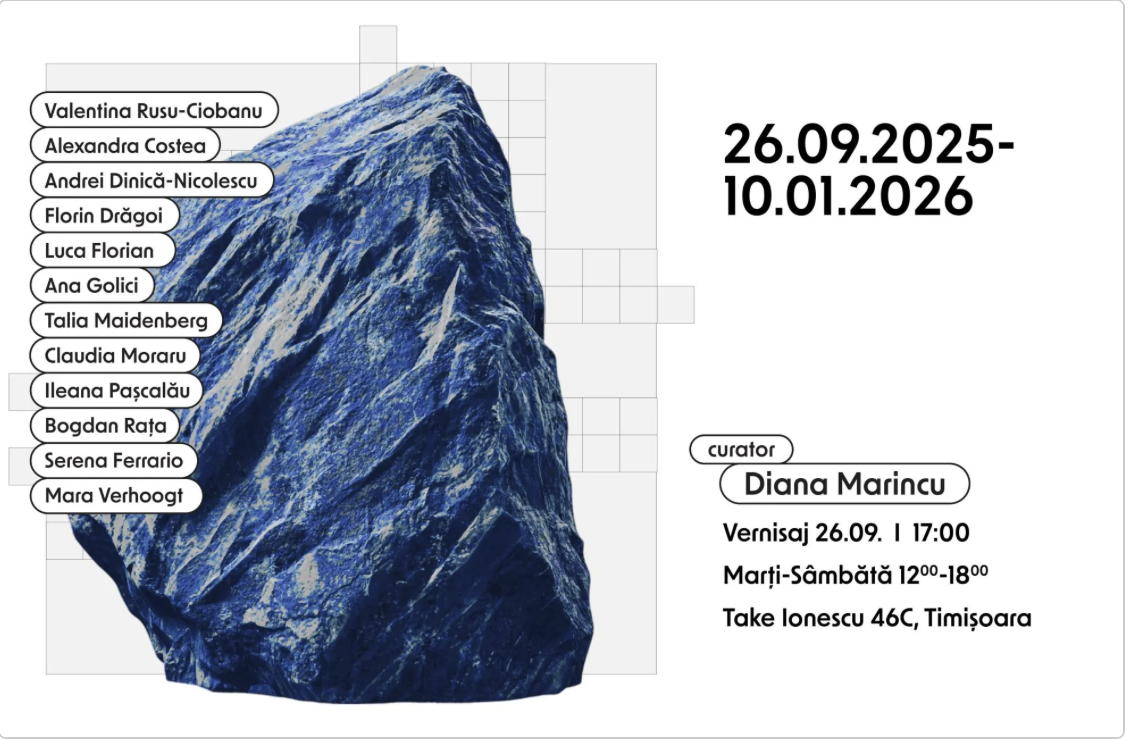
The themes that anchor the exhibition relate to the history of the body and sexuality, non-binary discourses on identity, the nomadism of today’s body, the fragility of human existence in relation to the planet, the universe, and the Other, but also the search for alternative micro-universes that only an artistic and sensitive “microscope” can find, either in nature or in dreams.
The title of the exhibition is taken from a verse by the English poet W. H. Auden, one of the most important poets of the 20th century. The fragment “No one has yet believed or liked a lie, / Another time has other lives to live.” concludes the 1940 poem Another Time and captures very well the disruptive political change in the world order that we are witnessing today. The shift in humanity’s relationship with the planet, the universe, our fellow human beings, and technology adds further layers of instability and fear. That is why this exhibition looks at human contact with otherness, with those who are familiar and those who are strangers, with imperceptible or even invisible beings,
with our projections and our perpetual shadows. [abstract on gallery wall]. “
You walk in and you go to the left, or at least I always do, and walk clockwise. I am sure there is some psychology to this that x% of the world population instinctively chooses left over right and then “explores” (because it’s not really exploring if it’s instinct) the space in a clockwise motion. Anyways, I know I am right because that is where the title of the exposition and abstract is painted on the wall (which you can read in the caption of the image above this paragraph).
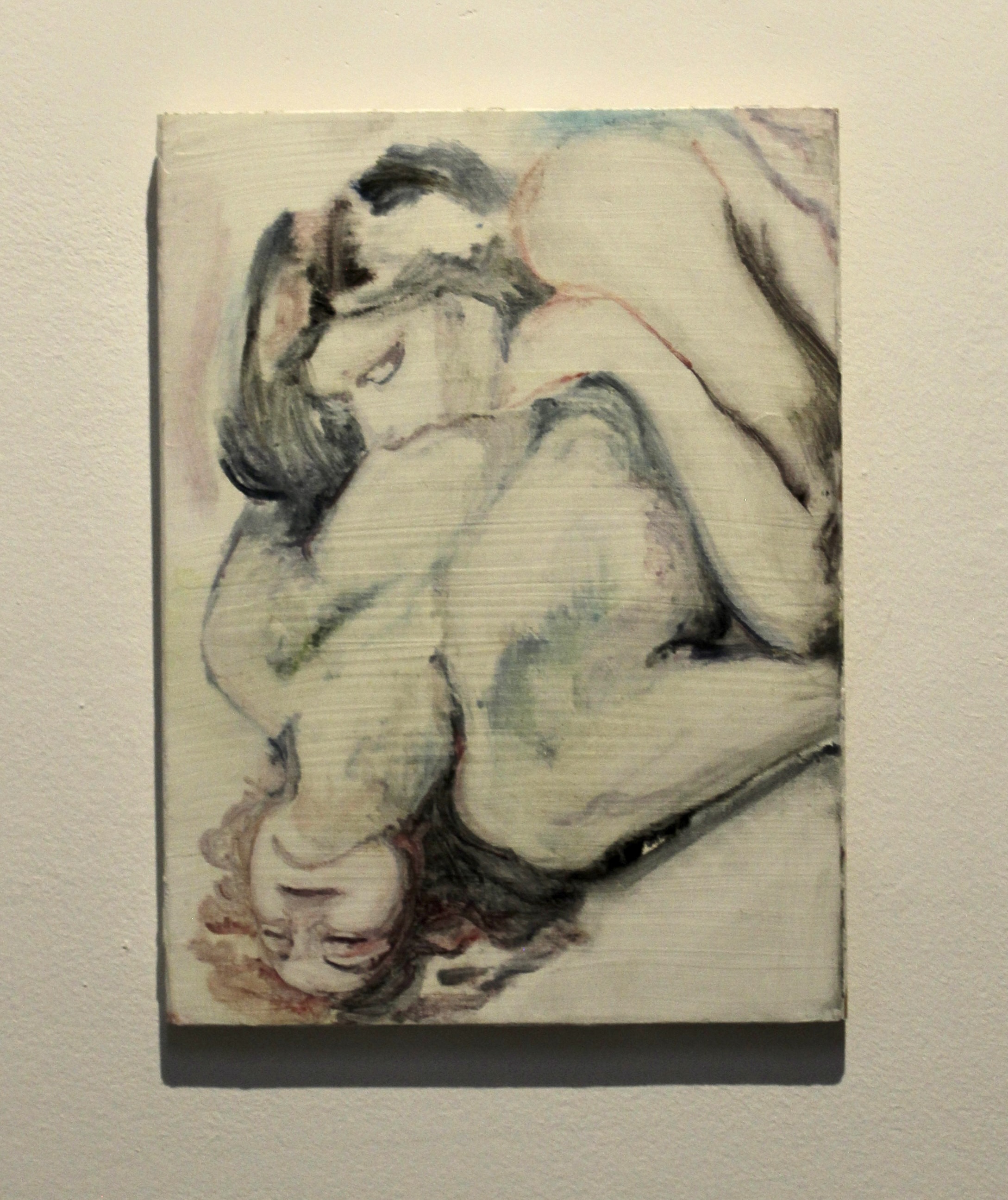
There are some sculptures on the wall that look like folded pieces of paper, but my eyes are immediately drawn to this painting, Moment Decisiv/Page Turner by Talia Maidenberg. It’s absolutely vulgar and I love it. The embrace, the folds of the skin, the top figure’s mouth around the breast of the bottom figure. Are they both women? Are either of them women?
It reminds me of Francis Bacon. It reminds me of something in one of my sketchbooks that I am unsure of having the courage to have anyone else lay eyes on at the moment. Yet the pastel colours, and barely there shading make the painting not so explicit. It’s light. It’s spacious and breathy. It’s lovely really. Maidenberg has a few other pieces I really enjoyed.
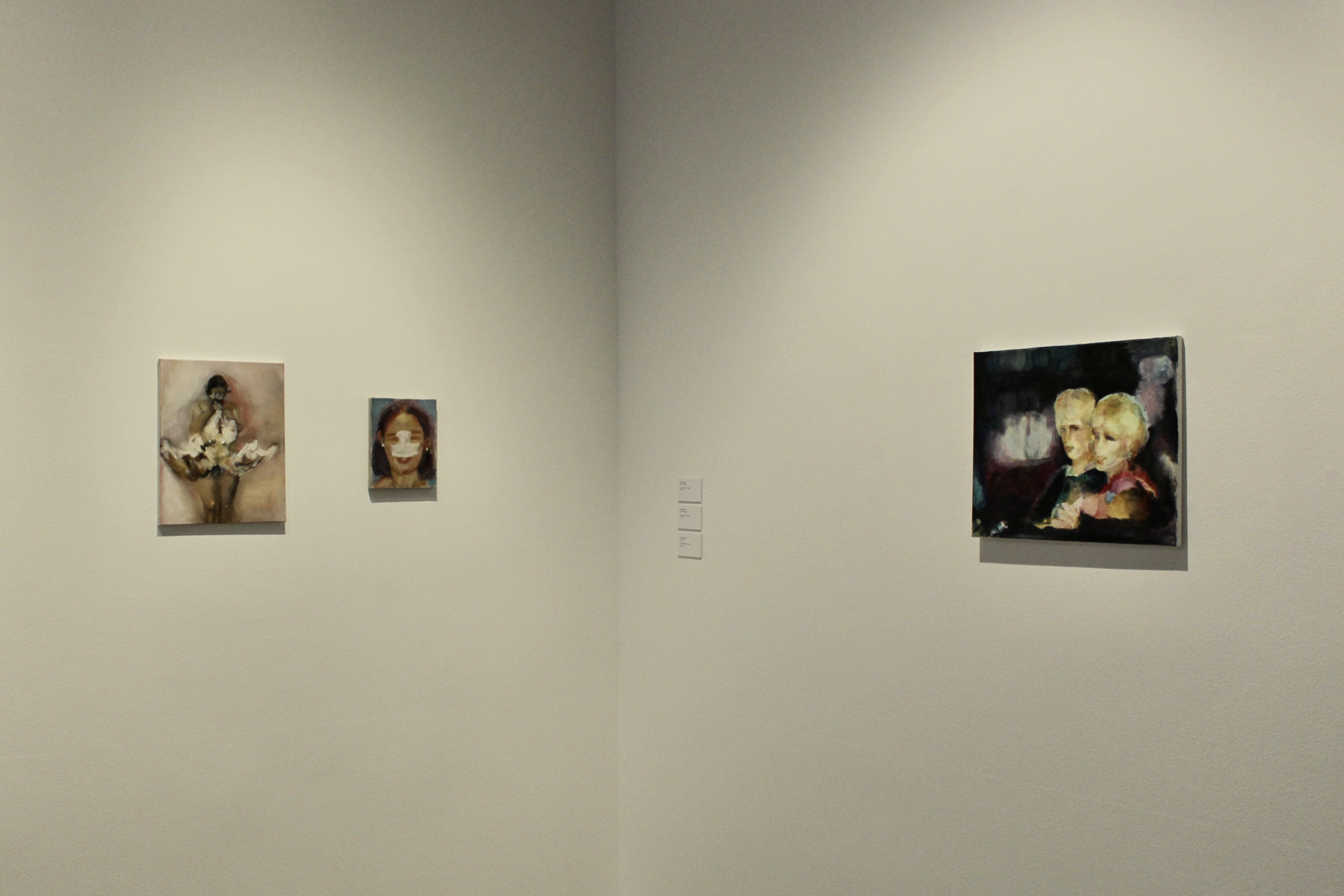
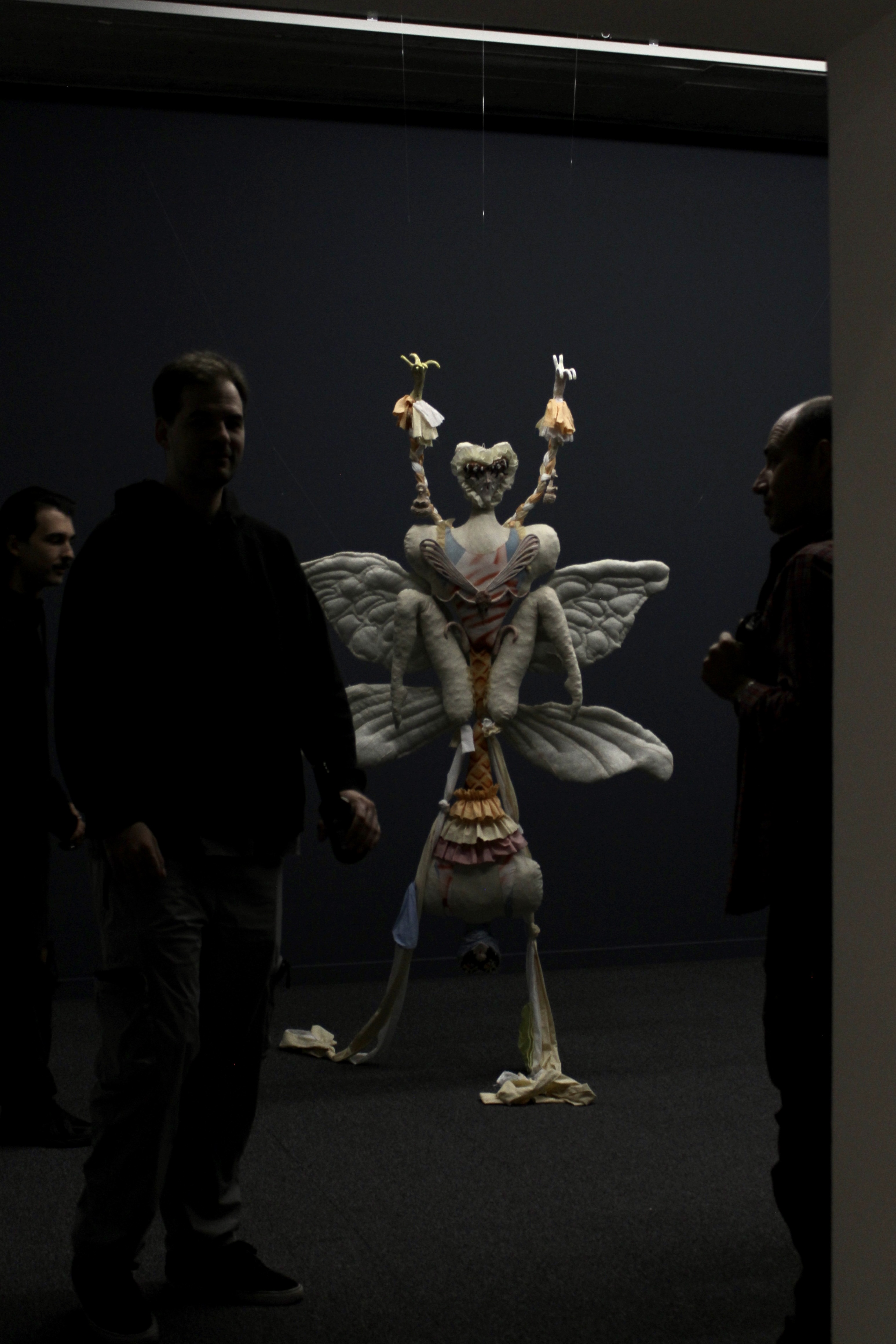
If I am looking at Maidenberg’s paintings behind me hangs a thick red curtain embroidered with gold line art of a woman sprawled horizontally. I do not go to look behind the curtain, instead I follow the big moth sculpture into the back, where my favourite piece (an installation) waits for me.
The following experience is an excerpt from my notebook, remember, I had a notebook and pen in one hand! I finally laid down the heavy coat and took a seat to watch the film, to look at the art installation Serena Ferrario has lovingly created for us. It is unedited, so bear with me. Transcribing it was a feat in itself. I wanted to edit and make it sound cohesive or at least coherent. I think it’s a bit more authentic word for word and mistake for missed comma:
19:46
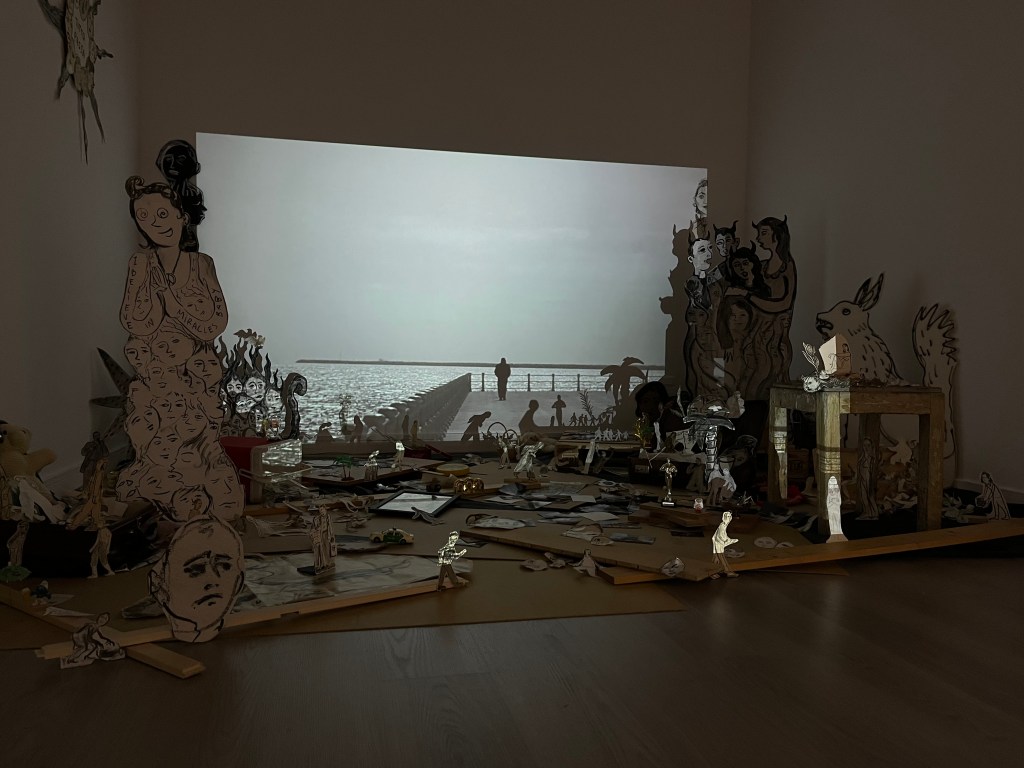
I have barely passed through the first room – where I viewed 3 paintings (4?) and a tapestry (a big red curtain) that has a human form outlined. The woman is sprawled horizontally across the sheet, when I am beckoned into a room where an installation is set up. a projector sits on the floor and plays a black and white movie along with soundtrack and everything. The half of the room with the projector is empty, but the other half is filled with pieces of wood and drawings of men and women. a suitcase is filled with paper dolls. A giant mouse (a scary mickey mouse) and a wolf? rabbit? The cartoon drawings that would otherwise take you back to a nostalgic childhood ( I say nostalgic because the floor is littered with suitcases, medals, icons of st Mary – basically things you would find in your grandmother’s house or attic, the mood is helped by the constant flow of short videos depicting moments in Romanian life. images that remind me of my childhood and riding the train to see my grandmother in Dr. Tr. Severin or across the country to Constanta. The paper dolls that are set up in front of the video cast shadows onto the wall the video is projected on. I have yet to read the artist’s description but for me this installation is a bitter nostalgic childhood. I have sat for a while have watched but I am yet to see the end of the loop – or to catch the frame when I sat down. At one point there is a clip of a fire pyre, it feels like the drawings, the paper dolls will burn up with the wood like easy kindling.
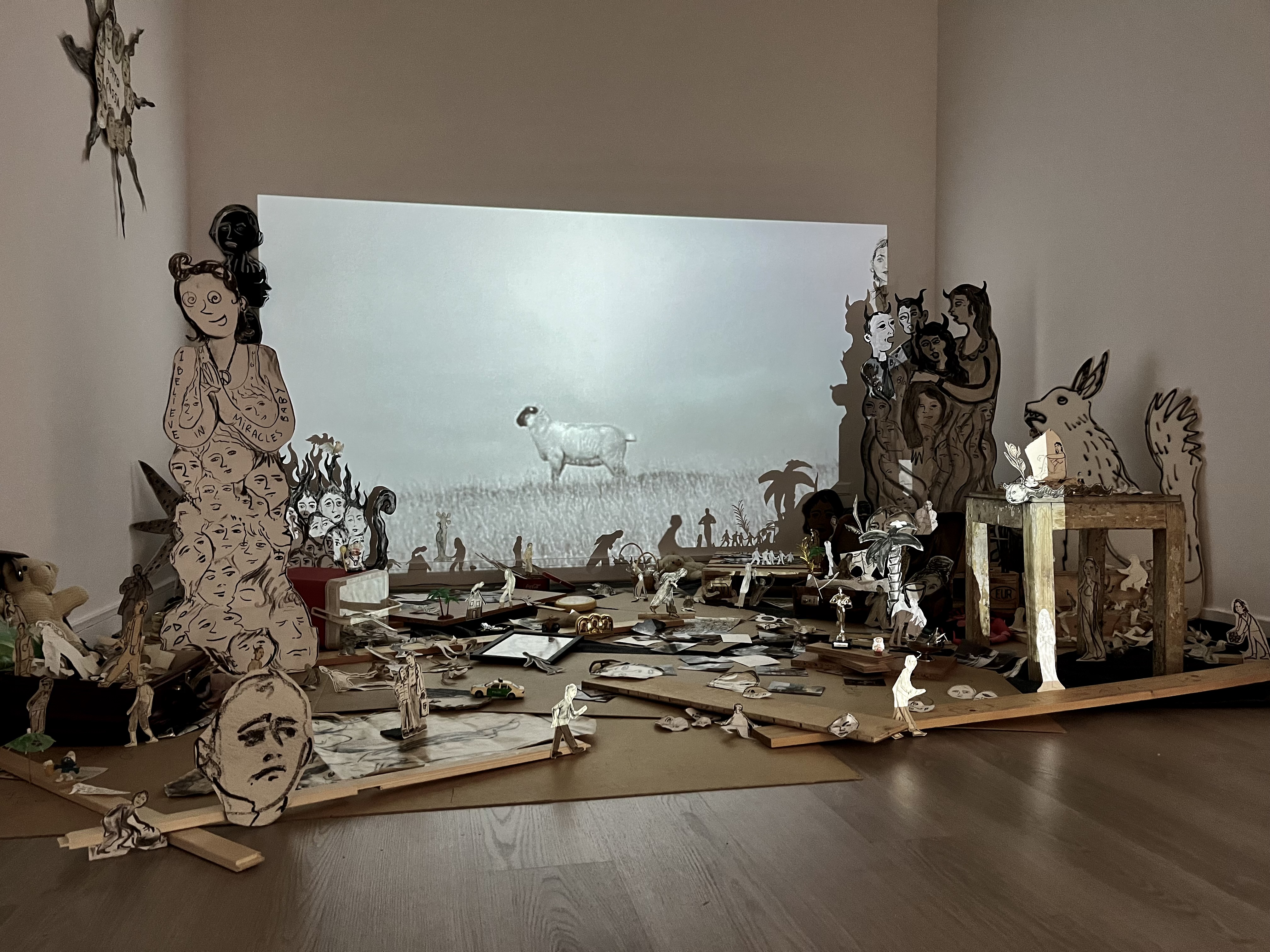
It’s a beautiful installation. I loved all of it. All that would be left to say is for you to go see, no, experience it yourself.
I walk back out into the room filled with Mara Verhoogt’s I Want to Be the Moment in a Dream sculptures. Moths. Ceramic Plates. Another sculpture, a woman’s bust embedded with perfectly round pearls of varying sizes lays on the floor (this one is a different artist), and four cyanotype portraits hang on the wall opposite the moth sculptures.
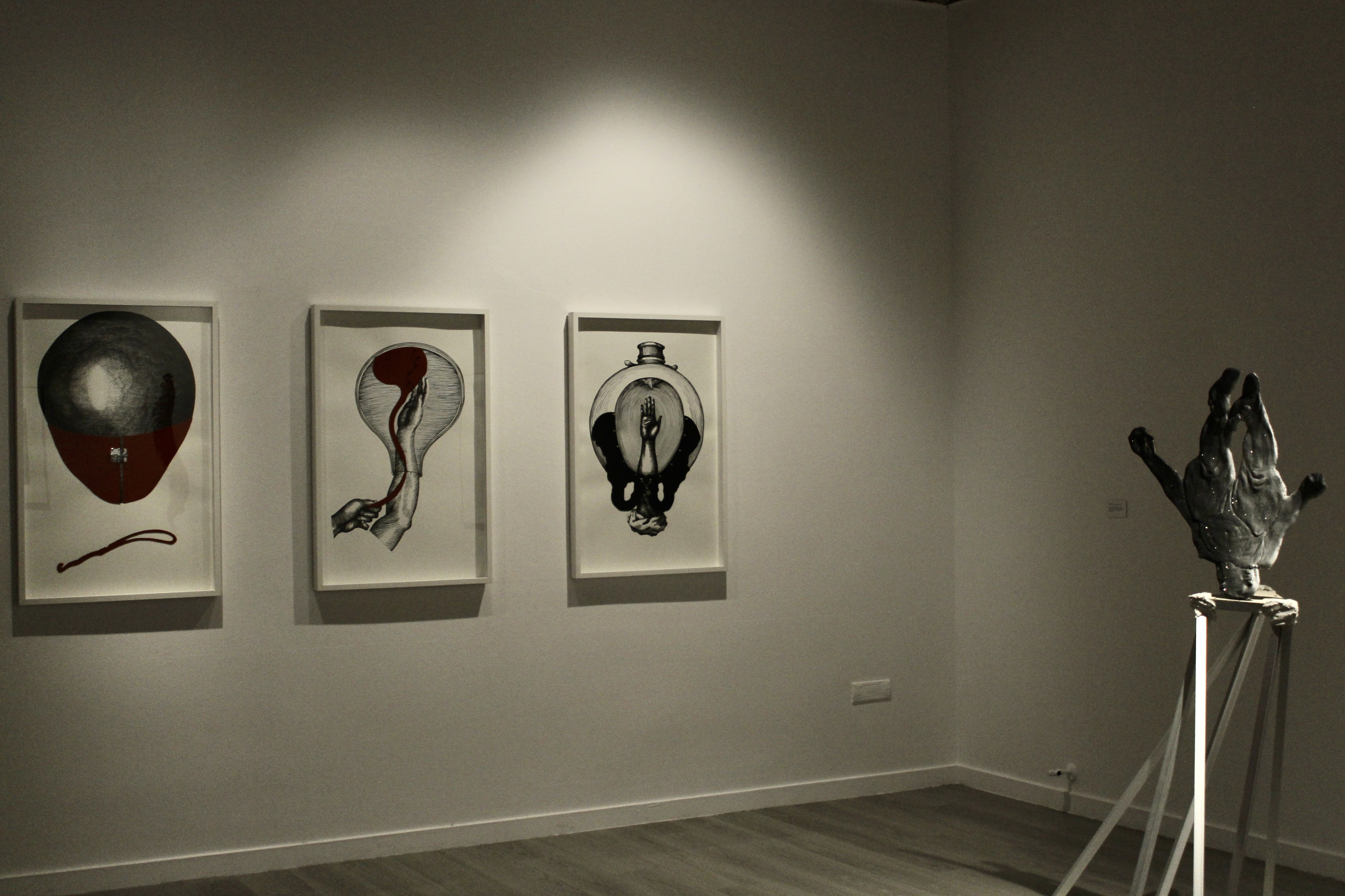
Perhaps it is unfair of me to note the names of the artists which I liked, while not even checking the names of the artist’s whose work didn’t leave a mark on me, but I digress.
Behind the red curtain is another sculpture, Bogdan Rata, an artist whose name I know and work I have seen in different cities in Romania, but would not be able to identify if I saw him on the street.
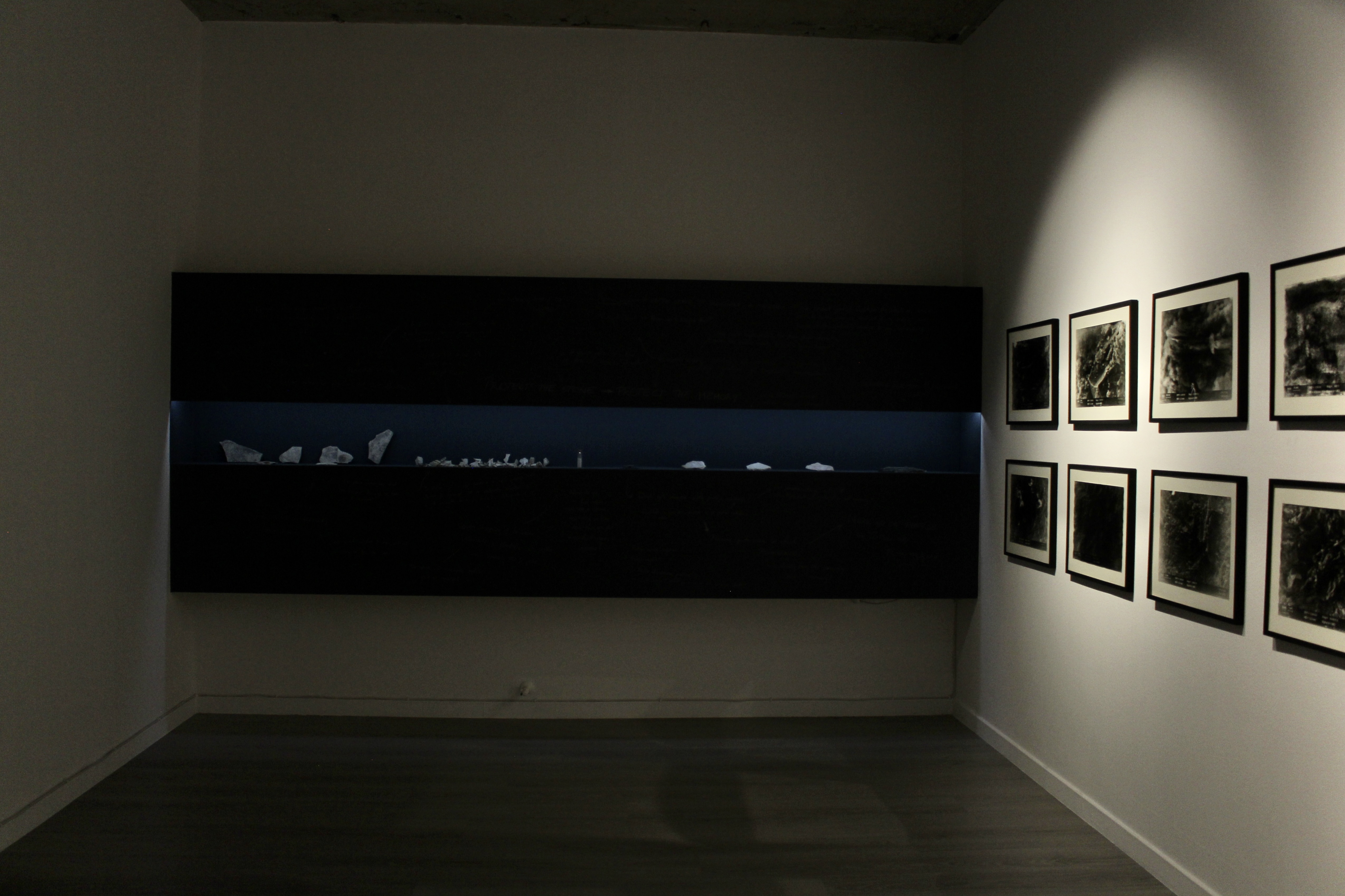
The rest of the exposition settles like the sand your toes kick up in the water. Alexandra Costea has a room to herself with a focus on rocks from differrent rivers in Romania. This is one of the conceptual pieces I was talking about. It’s set up nicely and there is enough thought put into it that it doesn’t bother me that the concept behind the work weighs (ha! because it’s rocks get it?) more than the aesthetic and technical value. I suppose you could argue that the technical value is in the time and effort it takes to crush the pieces of rocks down, and something about mixing them with plasma to preserve memory? I think I understood the piece 80% and for me it was enough.
The exposition has a few “paintings” – drawings(?) hanging in the next room but they are black canvas with graphite lines so they don’t hold my attention for longer than a moment.
The back room is filled with some drawings and photos of fleas. Diagrams and images and collages. Of fleas. If you are a pet owner then you probably have similar thoughts and feelings towards fleas. When I was about 14 our family dog (and cat) at the time had a flea infestation. My dad’s apartment had wall to wall carpets (it’s an American trend) and getting rid of the fleas was an absolute nightmare. It was months before we stopped seeing those little monsters, and to this day my skin beings to crawl when I hear anything about bugs this small. Horrific. So yes, I glanced, appreciated the effort in the details, and moved on.
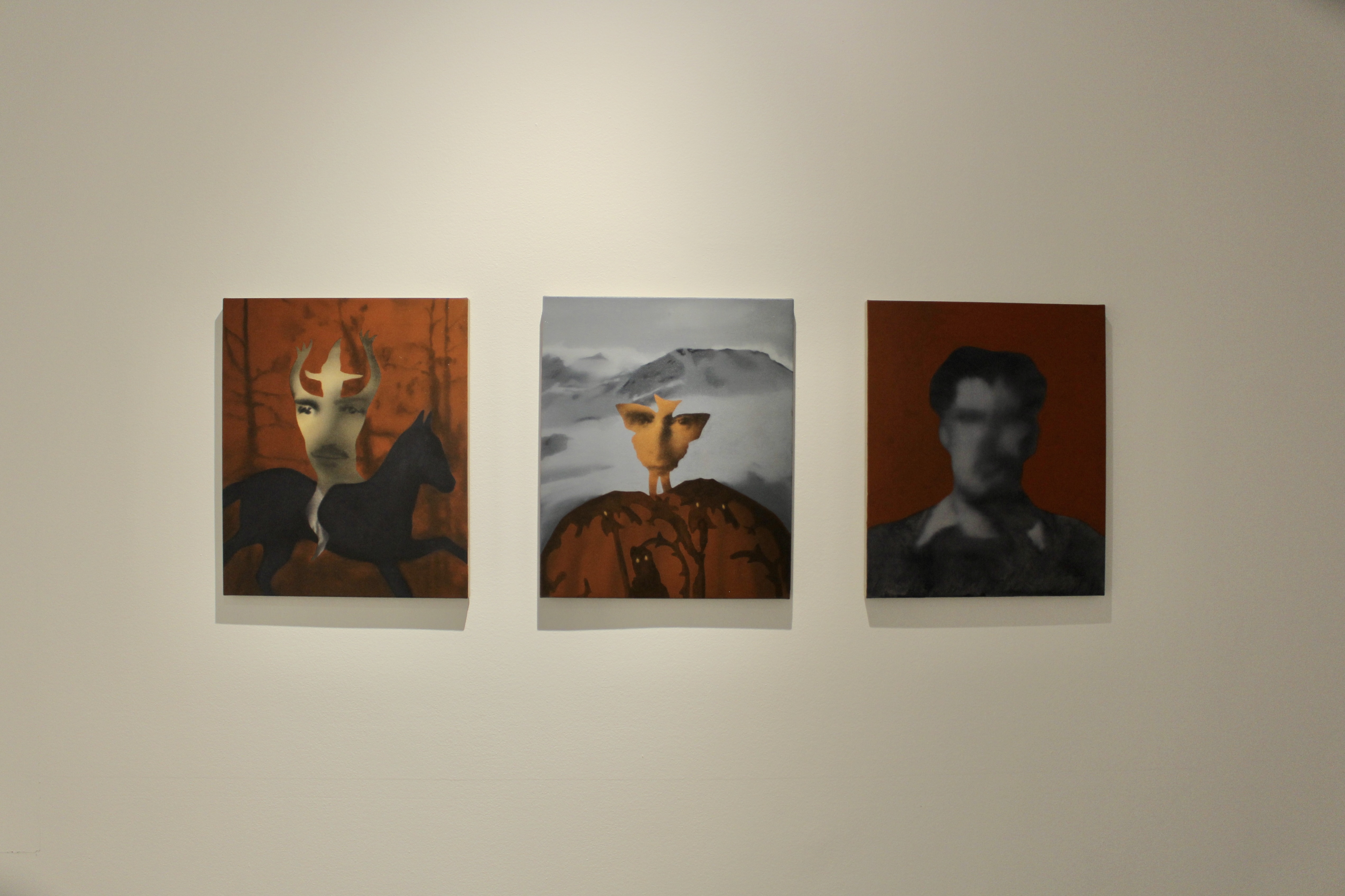
On the other side of the “Flea” room Luca Florian (above) had some cool paintings I liked and then there were a few photorealistic drawings by Florin Dragoi (I didn’t take pictures of Dragoi’s work but they were incredibly detailed).
This concludes my visit of Another Time has Other Lives to Live. It was thought provoking. Mostly it was enjoyable. The world is not in the best shape (it probably never is) and I want to see nice things. I want to see art where the artist cares. Where the artist likes to look at what they made and offers the viewer a window into their inner world.
I feel as though I should end the article with a question or a call to action, so here we are: How do you visit art exhibits?
 MARIA MICHAELA

Leave a comment